
BLOG
Ceramides vs Peptides
Aug
Ceramides vs Peptides: The Complete Guide to Choosing the Right Skincare Powerhouse
If you’ve ever stared at a skincare product label and wondered whether ceramides or peptides are better for your skin, you’re not alone. These two ingredients are among the most buzzworthy in modern skincare—and for good reason. But despite sounding similar, they serve entirely different purposes in your skincare routine. The short answer is that one isn’t “better” than the other; they work best as a team . However, understanding the difference between ceramides and peptides is the key to building a routine that actually delivers visible results.
What Are Ceramides? Your Skin’s Natural Shield
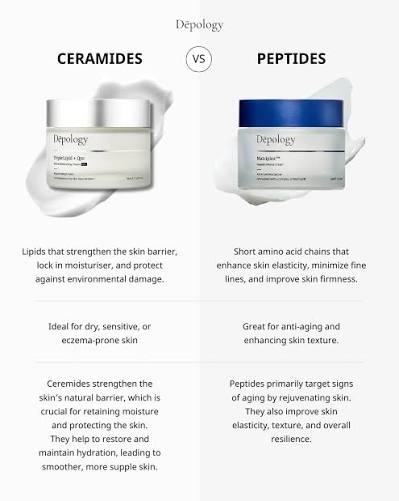
Ceramides are waxy lipid molecules that occur naturally in your skin . In fact, they make up approximately 50% of the lipids found in your skin’s outermost layer, the stratum corneum . This protective layer is your skin’s first line of defense against the outside world.
How Ceramides Work
Think of your skin cells as “bricks” and ceramides as the “mortar” that holds them together . This mortar-like barrier serves three critical functions :
- Locks in moisture: Prevents trans-epidermal water loss (TEWL), keeping your skin hydrated
- Blocks irritants out: Protects against bacteria, pollutants, and other environmental aggressors
- Maintains skin integrity: Keeps skin smooth, resilient, and less prone to sensitivity
Why Ceramide Levels Decline
As we age, our natural ceramide production decreases. Sun exposure, harsh cleansers, overuse of retinoids, and conditions like eczema can also deplete ceramide levels . When this happens, the skin barrier weakens—leading to dryness, flakiness, irritation, and increased sensitivity . A compromised barrier is also more vulnerable to free radical damage, which accelerates visible aging .
Who Benefits Most from Ceramides?
Ceramides are beneficial for every skin type, but certain concerns see the most dramatic improvement :
- Dry and dehydrated skin: Ceramides replenish lost lipids and restore moisture
- Sensitive or reactive skin: Strengthening the barrier reduces stinging and redness
- Eczema and psoriasis-prone skin: Barrier repair is foundational for managing these conditions
- Anyone using strong active ingredients: Ceramides counterbalance the drying effects of retinol and exfoliating acids
What Are Peptides? Your Skin’s Messengers
If ceramides are the protective structure of your skin, peptides are the communication system. Peptides are short chains of amino acids—the fundamental building blocks of proteins like collagen and elastin .
How Peptides Work
Peptides act as “messengers” that signal your skin cells to perform specific functions . When applied topically, they essentially send text messages to your skin saying: “Produce more collagen,” “Strengthen elastin,” or “Calm inflammation” . This signaling ability is what makes them so versatile.
Types of Peptides in Skincare
Different peptides have different jobs. The three main categories include :
- Signal peptides: The most common type, these directly tell skin cells to produce more collagen and elastin
- Carrier peptides: These deliver beneficial trace elements (like copper) deeper into the skin to support repair
- Enzyme inhibitor peptides: These block enzymes that naturally break down structural proteins like collagen
Who Benefits Most from Peptides?
Peptides are ideal for anyone looking to address visible signs of aging :
- Mature skin: They boost collagen to improve firmness and reduce wrinkles
- Loss of elasticity: Help restore bounce and resilience
- Fine lines and texture changes: Plump the skin from beneath to smooth the surface
- Post-acne scarring: Support the skin’s natural wound-healing process
Unlike retinoids, peptides are generally non-irritating and well-tolerated even by sensitive skin . However, consistency is key—most users notice initial hydration and smoothness within 2–4 weeks, but visible firming and reduced fine lines typically take 8–12 weeks of consistent use .
Ceramides vs Peptides: Key Differences at a Glance
Can You Use Ceramides and Peptides Together?
Yes—and dermatologists strongly recommend it . Ceramides and peptides are complementary ingredients that target different aspects of skin health . Peptides work from within to support the skin’s structure, while ceramides protect the surface barrier .
Think of it this way: peptides help rebuild the house, and ceramides keep the roof from leaking. When used together, they address both collagen loss and barrier decline simultaneously—a powerful combination for mature skin .
How to Layer Them
For maximum benefit, follow this simple order :
- Apply your peptide product first (typically a serum or treatment) to allow the active messengers to absorb
- Follow with a ceramide-rich moisturizer to lock everything in and seal the barrier
If your skin feels tight or reactive, prioritize ceramides for a few days before introducing peptides . And always finish with daily sunscreen .
Which Should You Choose Based on Your Skin Concerns?
Prioritize Ceramides If:
- Your skin is red, irritated, tight, or flaky
- You have a compromised barrier from over-exfoliation or retinoid use
- You struggle with eczema, rosacea, or extreme dryness
Prioritize Peptides If:
- Your main concerns are visible aging—fine lines, wrinkles, and loss of firmness
- Your skin barrier is already healthy but you want to target collagen decline
- You’re looking for a gentle alternative to retinol for anti-aging benefits
Use Both If:
You want comprehensive anti-aging and barrier support—which, frankly, most mature and proactive skincare users should . Both ingredients work synergistically, with ceramides creating a healthy environment for peptides to work more effectively .
Final Verdict
The ceramides vs peptides debate is ultimately the wrong question. These two ingredients aren’t rivals—they’re teammates . Ceramides provide the protective foundation your skin needs to stay healthy and resilient, while peptides send the signals to build and maintain a firm, youthful structure. For most people, the best approach is to use both: a peptide serum followed by a ceramide-rich moisturizer . Together, they deliver comprehensive skin health that neither ingredient can achieve alone.
Quick Recommendation
- Choose Ceramides If: Your skin is dry, sensitive, irritated, or barrier-compromised
- Choose Peptides If: You’re addressing fine lines, wrinkles, and loss of firmness
- Choose Both For: Comprehensive skin health, especially for mature or proactive skincare routines
